🌈 ESP32-S3 Rainbow: ZX Spectrum Emulator Board! Get it on Crowd Supply →
View All Posts
read
Want to keep up to date with the latest posts and videos? Subscribe to the newsletter
HELP SUPPORT MY WORK: If you're feeling flush then please stop by Patreon Or you can make a one off donation via ko-fi

A little while back I ripped the PIR and mystery chip out of one of these cheap night lights and dropped a microwave radar module in its place. It worked beautifully: much better sensitivity, sensible timeout, the whole thing tucked back into the original case like nothing had happened.

But I had a sneaking suspicion I might have improved one thing and quietly ruined another. The radar module is always on. The PIR-and-mystery-chip combo, on the other hand, looked like it was doing something clever with sleep. So before I get smug about my mod, let’s actually measure what each version is pulling from the battery.

Out comes the Nordic Power Profiler Kit II.
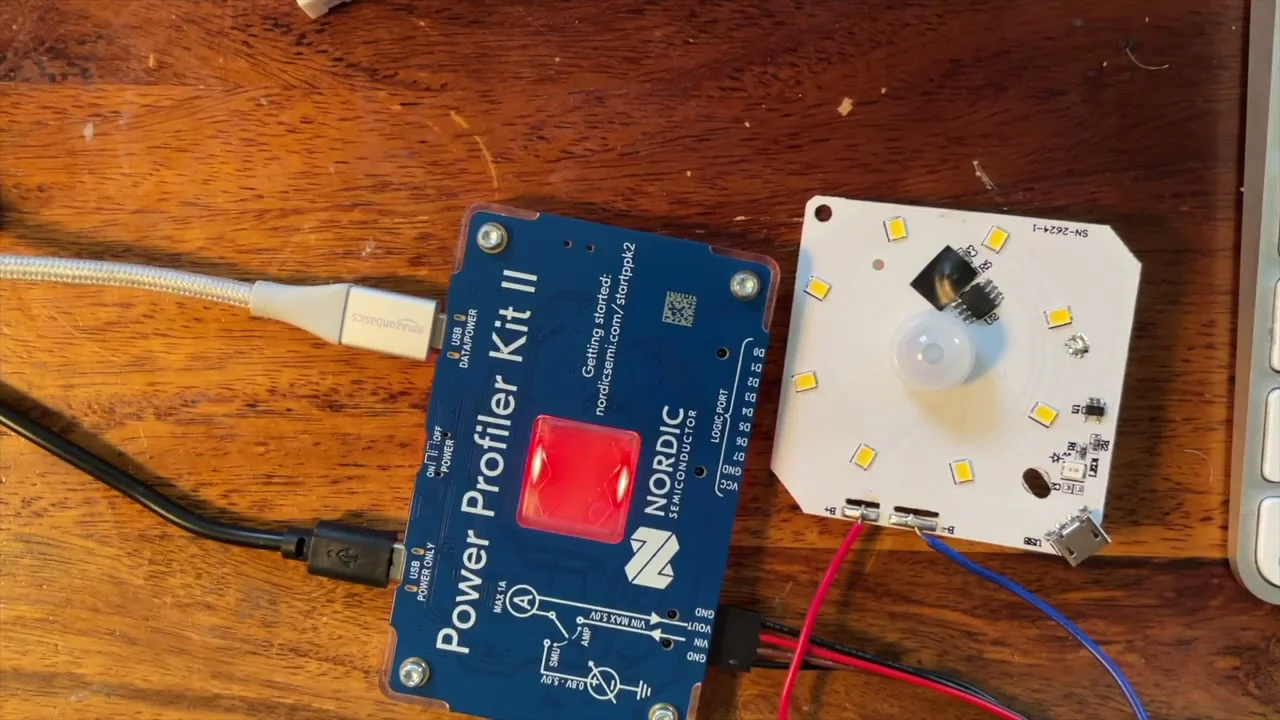
PPK2 wired up to the original night light PCB

The Original: LEDs On

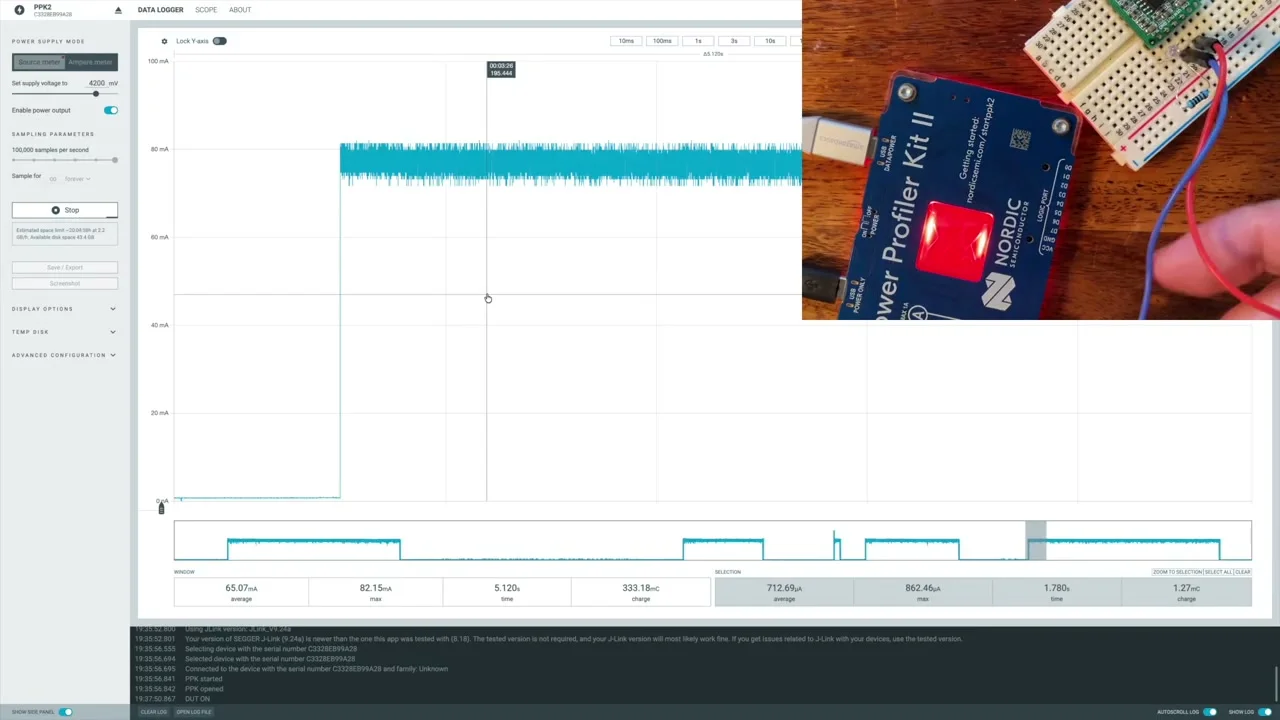
Power the supply on, start logging, and the LEDs immediately come up to greet me. It takes a moment to actually trigger because I’ve taped over the LDR (the night light flatly refuses to light up unless it thinks it’s dark), but once it triggers we’re sitting at about 80 mA, which matches the last time I measured this on the bench.
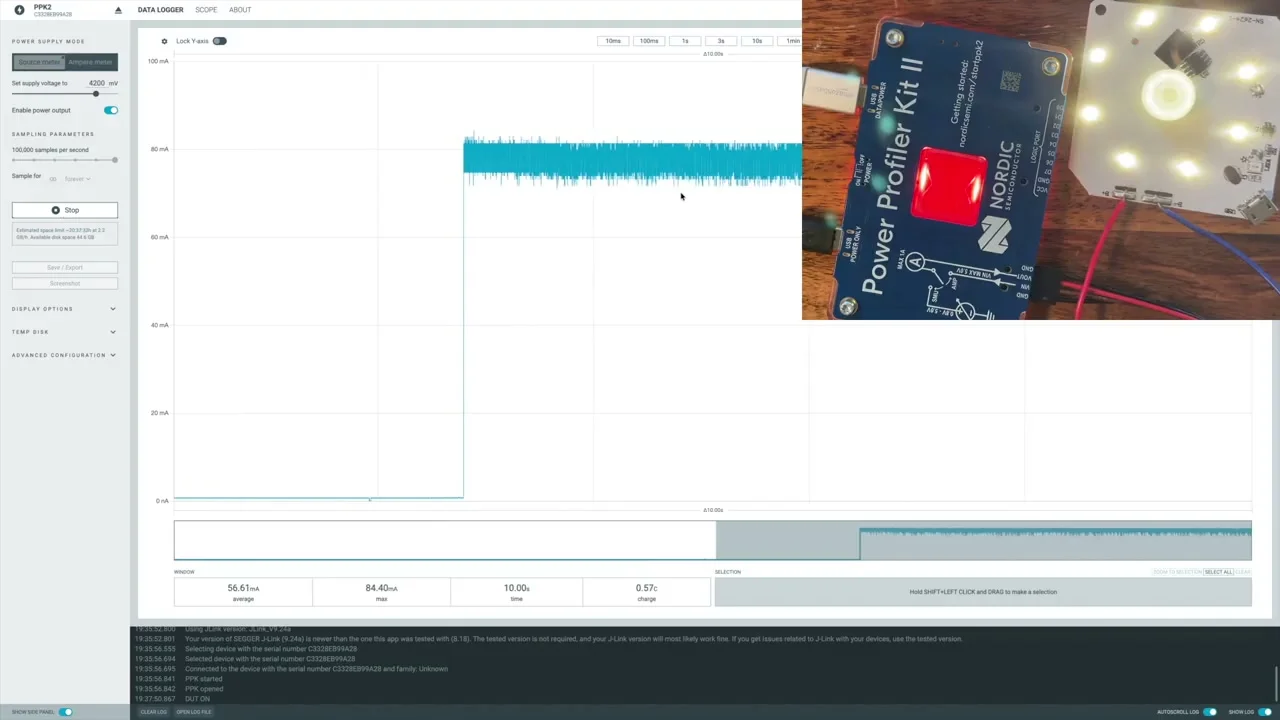
PPK trace with the LEDs on, drawing about 80 mA

That’s the easy bit. The interesting question is what the board does when it’s not lighting up.

The Original: Waiting Mode

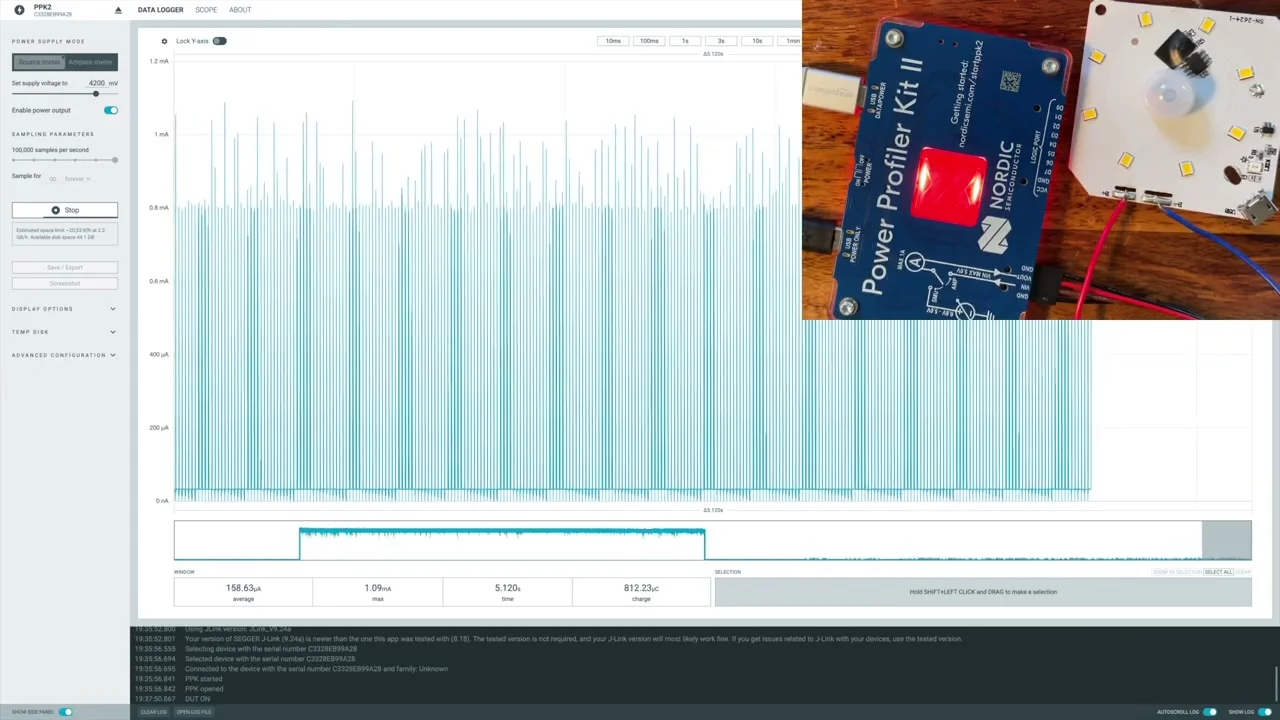
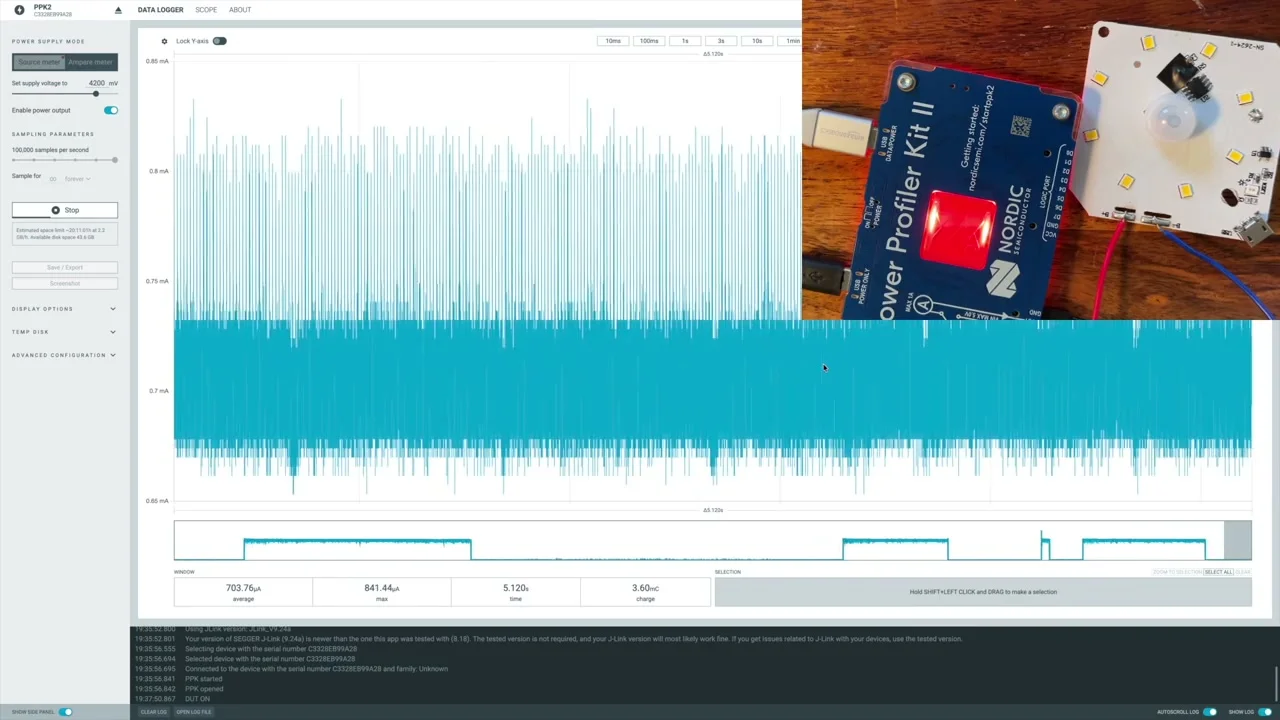
Wait long enough for the LEDs to time out and the trace drops off a cliff. The board settles into a “waiting for movement” mode at roughly 700-800 ”A. Fine, that’s basically what a comparator and a small MCU sipping at the PIR signal ought to look like.

But then something weird starts happening. Every so often the trace drops down to a tiny fraction of that. Not lower-by-a-bit. Much lower, about 30 ”A.

The mystery chip's pulsed ultra-low-power mode

It sits down there for a while, then briefly pops back up to a few hundred microamps, then drops again. It’s clearly a sleep-and-poke pattern: the chip is mostly asleep and only briefly waking up to look at the PIR. As long as I don’t move, it stays in this ultra-low-power mode pretty much indefinitely.

That’s actually really impressive for a chip with all its identifying marks sanded off.

Doing the Maths on the Original

Scroll back to a chunk of the ultra-low-power section, drag a selection across it, and the PPK helpfully spits out the average: 72 ”A.

Selecting the ultra-low-power region: 72 ”A average

And during the noisier “actively monitoring” segments it’s averaging more like 700-800 ”A. So depending on what mood it’s in, the original is sipping between 72 ”A and around 0.8 mA. Whichever number we pick, on its 350 mAh cell that’s a lot of standby time. In theory the 72 ”A figure puts it at something like 200 days. In practice it definitely doesn’t last that long, but the cell is almost certainly not really 350 mAh either.

The really annoying thing is that I already know from living with these things that the original barely triggers. So all that lovely low power gets wasted because the night light isn’t actually on when you want it to be. Which is, you know, the entire point of a night light.

My Mod: On the PPK

Swap the leads onto the radar version. There’s a current limit resistor in series with the indicator LED here so I don’t have to worry about the LED itself drawing a lot.
Radar-modded board hooked up to the PPK

Wait the ~40 seconds for the radar’s extended timeout to expire (that big cap on the CTM pad is doing its job) and then we get to see the real story.

My Mod: Idle Current

LED out, no movement, just sitting there waiting. The trace settles into a fairly fat band of noise centred around 2.85-2.9 mA.
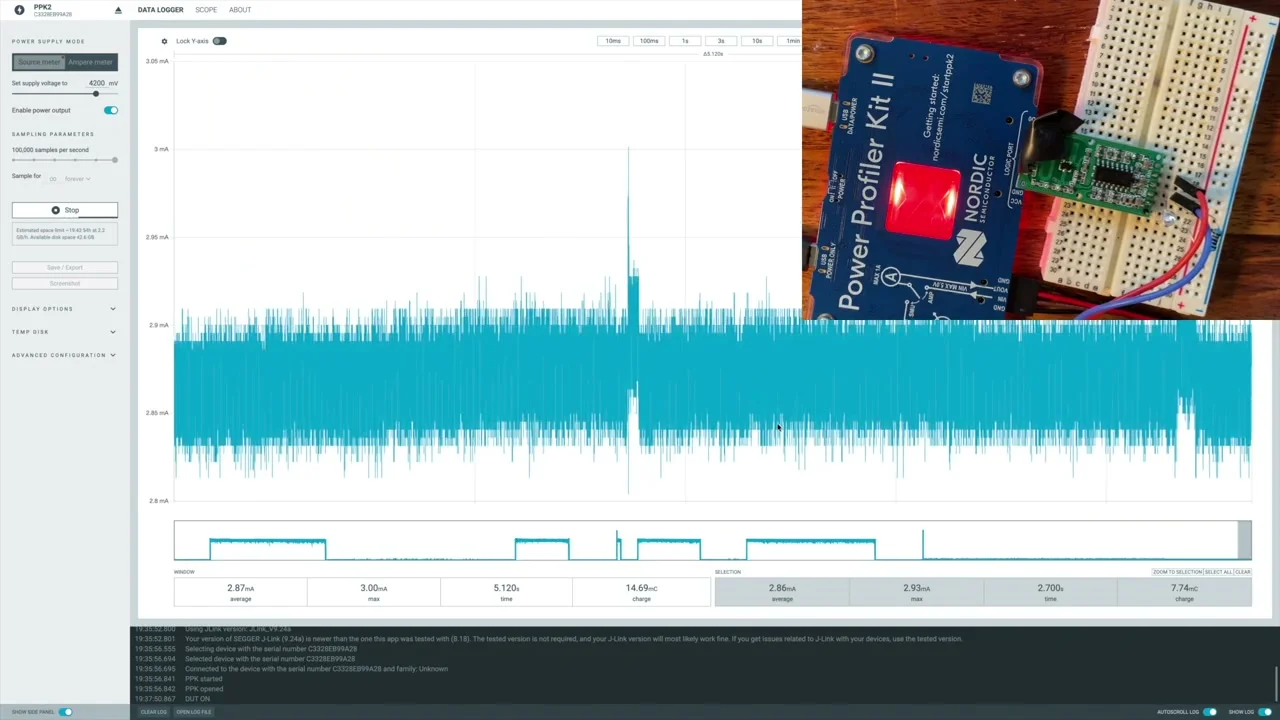
Radar version drawing 2.85 mA at idle

I tried covering and uncovering the LDR to see whether the radar module was doing anything clever with it. Does it actually shut down in daylight, or just gate the output? Spoiler: it just gates the output. The module itself draws the same ~2.86 mA whether the LDR thinks it’s bright or dark. The LDR is purely there to stop the LEDs lighting up during the day, not to save power.

Honestly, 2.8 mA isn’t that bad for a radar module that’s continuously transmitting and listening. It’s just a lot more than 72 ”A.

So
 Did I Make It Worse?

Time to be honest with the numbers.
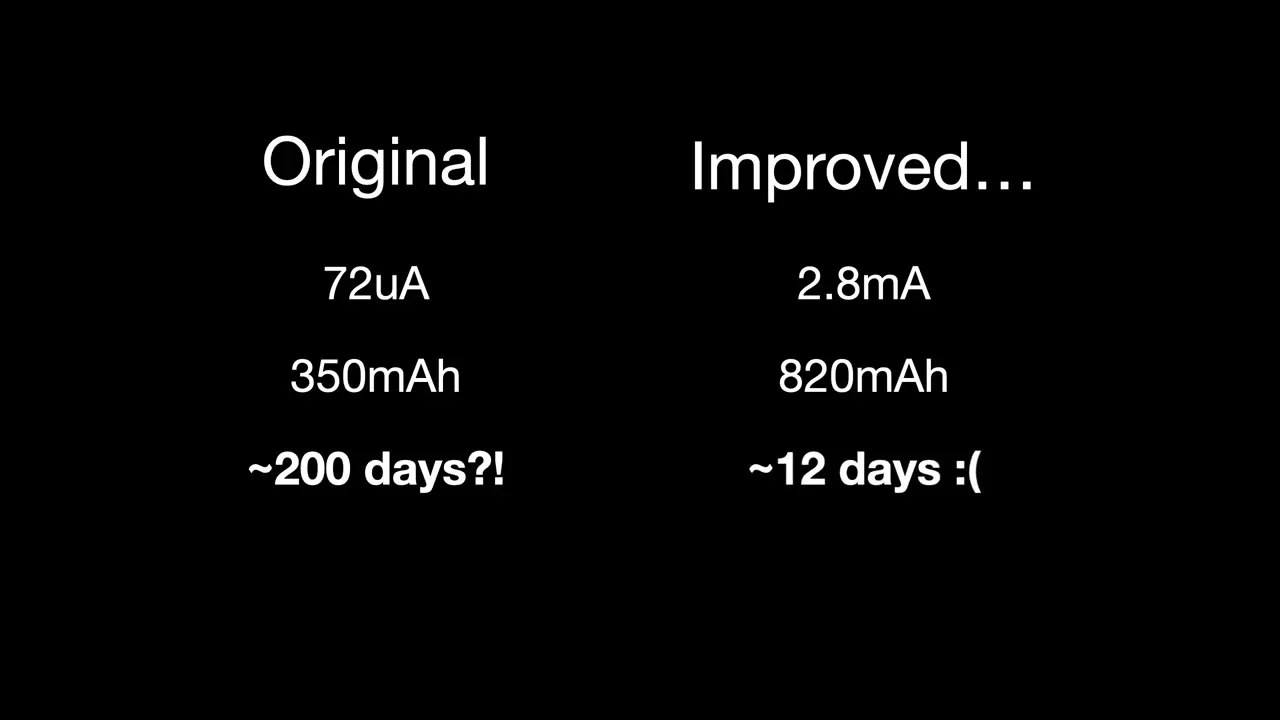
Original 72 ”A / 350 mAh / ~200 days versus Improved 2.8 mA / 820 mAh / ~12 days

On paper, the original on its sad little 350 mAh cell at 72 ”A average should run for around 200 days. My “improved” version at 2.8 mA on the 820 mAh cell I fitted comes out at
 about 12 days.

Ouch.

In fairness, the original definitely doesn’t get anywhere near 200 days in real life, partly because the cell is optimistic and partly because every actual trigger spends time at 80 mA. And my mod actually triggers reliably, which the original conspicuously does not. But still, twelve days between charges is rubbish for something that’s supposed to live on a wall.

Salvaging It

All is not lost. I’ve got a stash of much beefier 2000 mAh cells that physically fit inside the case if I’m a bit careful about packaging.
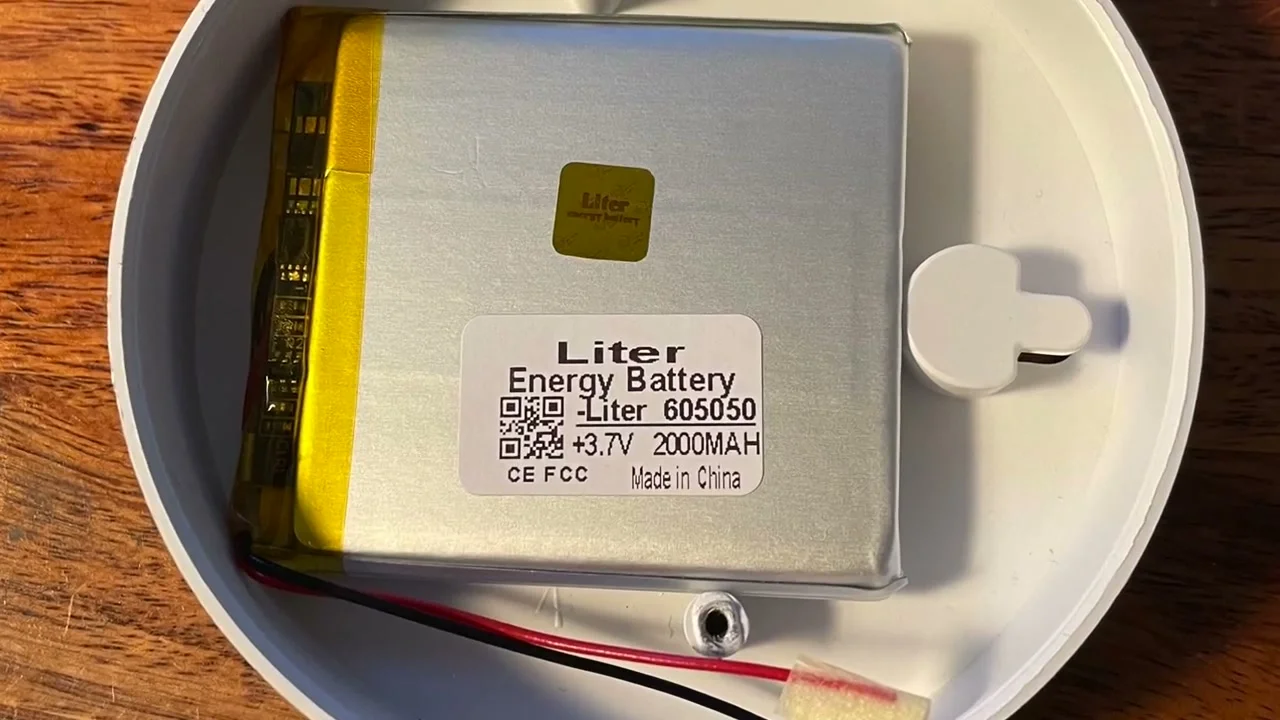
2000 mAh Liter Energy Battery dropped into the case

Swapping that in gets the modded version to roughly 30 days between charges, which is much more like it. Not as flashy as “charge it four times a year”, but I’ll actually believe 30 days from a thing that genuinely turns on when I walk past.

So yes: strictly on standby current, I made it considerably worse. But factor in “does it actually do its job”, and a bigger cell, and I think I’m still ahead. Just.

The bit that’s still nagging at me is the original. Whatever that mystery chip is doing in its sleep mode is really nicely done; 72 ”A average is properly low. If I could find a way to make the original trigger reliably, I’d have basically the perfect night light. That’s probably a project for another day.

If you want to watch the meters in motion (including the satisfying moment when the trace drops to a pancake-flat 30 ”A), it’s all on YouTube.

Related Posts

Hacking a Cheap PIR Night Light Into Something Actually Useful - Sick of flaky PIR night lights with laughable range and timeouts, I cracked one open, reverse‑engineered the sanded‑off mystery chip, and swapped the PIR for an RC‑WL0516 microwave radar. I added an LDR, bumped the timeout with a cap, drove the LEDs via a MOSFET and resistor, and upgraded the cell to 820 mAh—all neatly tucked back into the original shell. Result: way better sensitivity, sensible timeout, and battery life that should finally match the hype. It works. Now to do the rest of them.
75% Less Power! - Saving the Planet With Motion Sensing and Image Processing - In this blog, I was dealing with a conundrum on how to reduce the power consumption of my cool magic mirror that was always on, always drawing power. I considered options such as a PIR (Passive Infra Red) sensor and a doppler radar microwave motion sensor. The latter worked brilliantly except for a few too many false positives. Things got technologically fancy when I introduced a camera for motion detection and face recognition, even recognizing who is in front of the mirror! However, while it was fascinating, it upped the power consumption which was against our original goal. After combining everything into an impressive package and even forming simple state machine, I found that the sophisticated system needed more work. Conditions like lighting and screen turn-on time presented challenges. However, it did make a significant difference - nearly running at 25% of the original power consumption. Definitely a promising and interesting project worth looking into further!
10 Cent Music Machine - I built a tiny coin‑cell music board around the $0.10 WCH CH32V003J4M6 (8‑pin, 48MHz RISC‑V, 16K flash/2K RAM). The PCB is just 16.3×11.7mm with a piezo buzzer and transistor, and in standby it sips 7–8”A. I did hit a snag: playback caused 130mA peaks that browned out a CR2032. A LiPo fixed it, but I really wanted coin‑cell, so I upped the buzzer’s base resistor to 10k, dropping peaks to 56mA and average to ~7mA—now it runs happily (and loudly) from a coin cell. Pro tip: if standby bricks programming, wlink can erase via power-off mode. I’m bit‑banging audio, published a simple MIDI→buzzer tool with a 1‑bit SFX generator, and all the code’s on GitHub.
I got this feeling bezos is watching - Discovered my Hue switch battery performance is correlated with room temperature after a nifty web scrape of Amazon's device usage history. While it's a given that batteries are temperature-sensitive, actual data from my own living room provided a neat confirmation, graphing a daily pattern. Wanted to go green with a rechargeable lithium coin cell, but the voltage risk to the ATmega256RFR2 on the PCB is a no-go. For now, it's back to the humdrum world of regular coin cells and unexciting battery charts. Dive into the video for a deeper geek-out on this!
I Built a 27V Circuit to Fix This $3 Gadget - I revived a cheap scribble pad by swapping its fried board for a tiny PCB that boosts a coin cell to 27 V—enough to cleanly reset the bistable LCD. It’s a Joule Thief with Zener regulation and twin 220 ”H inductors (mounted in opposite orientations), pulling ~17 mA during charge and ~7 mA while regulating. It’s coin-cell friendly, works great, and just needs a bit of case surgery for a perfect fit.

Related Videos

Did I Ruin These Night Lights? - I cracked open some cheap night lights and thought I’d improved them with a radar sensor—turns out, maybe not. With the Nordic Power Profiler, the stock board sips ~72 ”A in ultra-sleep (~0.8 mA while monitoring, 80 mA with LEDs), but my radar mod idles around 2.8–3 mA and the LDR only gates the output, not the IC. That means ~12 days on an 820–850 mAh cell or ~30 days with 2000 mAh, while the original could hit ~200 days on 350 mAh if it would just trigger properly—so I’m going to investigate that.
Making this CR*P Night Light GOOD - I've been picking up cheap motion night lights—performance meh, battery life definitely not 'four charges a year'. So I cracked one open for a Big Clive-style reverse-engineer: TP4054 charger at ~300 mA into a tiny 350 mAh cell, an 8-pin mystery PIR/LED driver taking the PIR and LDR directly and sinking the LED cathodes. No visible current limiting on the board, but measured ~68 mA on the bench so it's baked into the chip. Then I gutted the brains, dropped in an RC-WL0516 radar sensor, added an LDR and a timing cap to stretch the ~3 s timeout, and drove the LEDs with a MOSFET and proper current limiting. Swapped in a bigger 820 mAh battery, reassembled so it still charges and looks stock—and now it actually works nicely. Also, bonus anti-subscribe jam. Good as new.
10Âą MCU Brain Surgery - CH32V003 - I crack open a punchy little toy, show how the original just squishes two contacts to light the eye LEDs off a pair of LR41s, then perform some brain surgery to cram in a tiny lithium cell and my own board that triggers lights—and an incredibly annoying tune—on each punch. It sips about 7 ”A in deep sleep and wakes via a yellow trigger wire, but the soldering was fiddly and full of swearing. Tape it up, cram it back in the head, and yes, it works a treat
 maybe too well, because the beeping is driving me mad.
10Âą MCU Music Hack - CH32V003 - I spun some tiny WCH boards at PCBWay around an 8‑pin MCU (48 MHz, 16k flash, 2k RAM) to beep tunes off a coin cell. I tried hand-soldering, then used my paste-dispensing PCB printer—expired paste still worked great. Standby sips under 8 ”A, but it locks out programming; a WLink flash wipe rescued me. Wake draws ~3.3 mA, and audio peaks hit ~130 mA (~13–14 mA average), which browned out the coin cell. A tiny 80 mAh LiPo with a TP4056 (modded to ~100 mA) proved the design, then swapping the buzzer’s base resistor from 1k to 10k tamed it to ~56 mA peak and just over 7 mA average—coin cell friendly and still loud. I’m bit-banging audio for now (PWM/timers later). I also made a quick MIDI-to-note tool and a one-bit SFX generator. These boards are heading into my next project—stay tuned.
Another Street Battery Salvage - In this video, I plucked a battery from a Honey Melon street crystal, ending up with another 500-milliamp hour battery to add to my growing collection. After checking the connection, I added a protective PCB and tested the battery - a reasonable 3.5 volts at a flat level. Following the safe soldering of wires and wrapping it up, I hooked the revamped battery to my charger. It showed promising results, charging quickly at one amp with voltage visibly on rise. After a full recharge, I performed a load test which unfortunately gave a disappointing 311 milliamp hour. It falls short of my other salvaged batteries – 500 and 550 milliamp hour, but nonetheless, it’s a fine addition to the collection.
HELP SUPPORT MY WORK: If you're feeling flush then please stop by Patreon Or you can make a one off donation via ko-fi
Want to keep up to date with the latest posts and videos? Subscribe to the newsletter
Blog Logo

Chris Greening


Published

> Image

atomic14

A collection of slightly mad projects, instructive/educational videos, and generally interesting stuff. Building projects around the Arduino and ESP32 platforms - we'll be exploring AI, Computer Vision, Audio, 3D Printing - it may get a bit eclectic...

View All Posts